
What the work explores
A portrait changes as people stop in front of the camera. It takes a description of the eyes from one participant, the shape of the face or the hair from another. Each new image builds on the previous one, combining these contributions into a fictional face that is constantly changing.
Feature Fusion explores the relationship between participation, representation and the interpretation of an image through artificial intelligence. The observed features first pass through language: they are selected, described and then reinterpreted in a portrait. Words thus become an essential step between the person in front of the camera and the image the audience sees.
The work makes this process visible. The Portrait screen shows the result, Perception lets visitors follow the analysis, and Memory brings together the images created over time. Participants' presence and movement also influence the sound composition, connecting the changing face to the experience of the exhibition space.
The installation in the exhibition
Feature Fusion, created by Deian Berar, is part of Sensing the Data, Practicing the Care — Living Planetary Circuits, the exhibition by smART + TECH + NATURE Lab, within the Faculty of Arts and Design at the West University of Timișoara. The project brings together six works exploring relationships between art, technology and the environment, coordinated by Aura Bălănescu, the exhibition's curator.
The exhibition is scheduled to take place at Comenduirea Garnizoanei in Timișoara from 6–15 November 2026, as a satellite event of ISEA Dubai 2026. The official Feature Fusion page presents the work, while the exhibition website presents the other projects and the exhibition programme.
01. Portrait — an individual contribution to a collective face
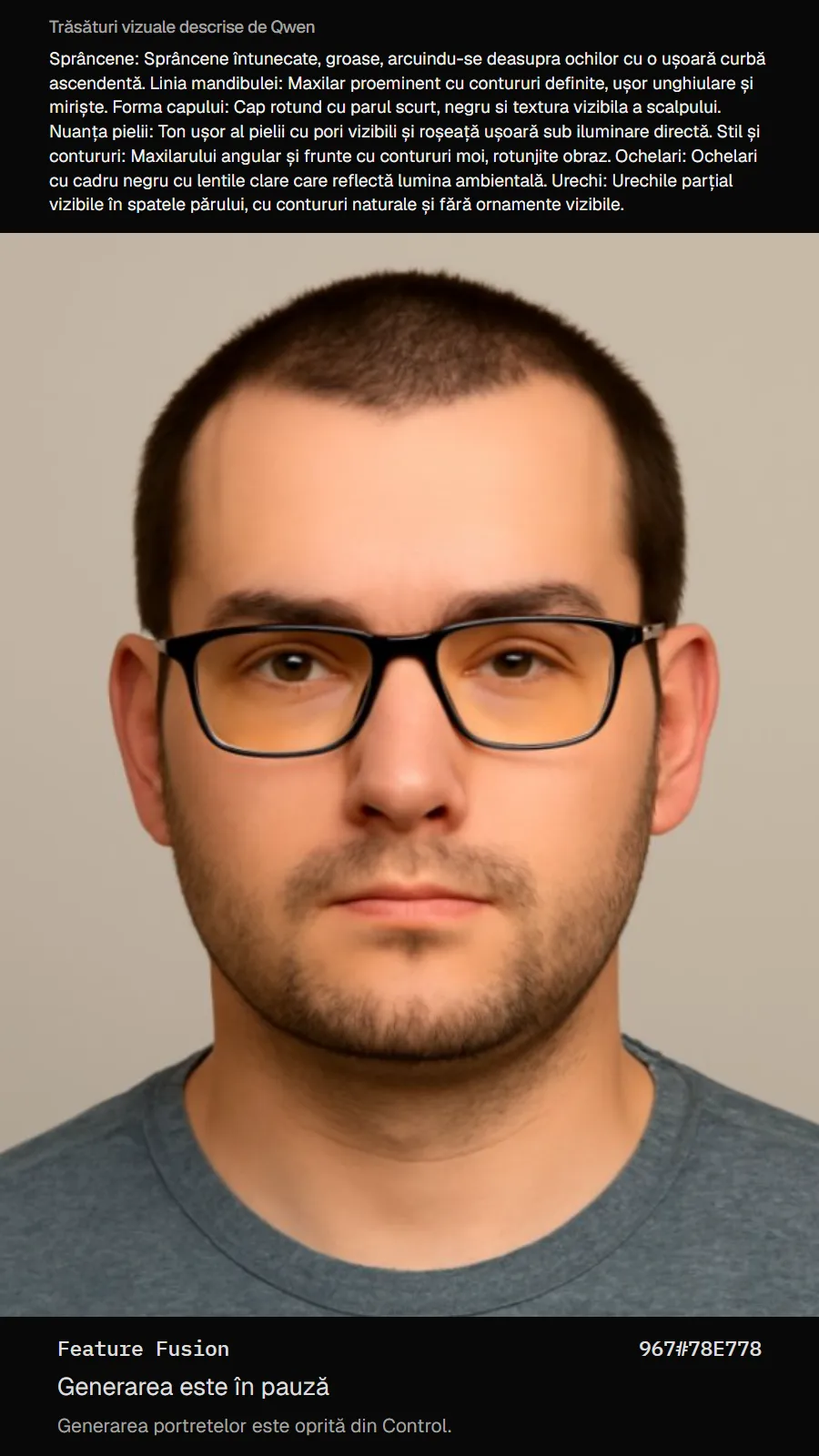
The first screen presents the face in its current form. The text above the image describes the features associated with the portrait and offers a point of comparison: how do the eyes, hair or facial contours described in words appear in the image?
Participation is cumulative. The new description is used to transform the existing portrait, so that each encounter continues an image begun by others. Some changes are subtle; others visibly alter the face's appearance. The collection preserves these stages.
How a description becomes an image
Qwen is the AI model that analyses the photograph and describes the selected features. This analysis takes place on the installation's device. The description is then sent to OpenAI's image generation service, together with the previous portrait when it is being transformed.
There are therefore two distinct stages between the visitor's photograph and the final image: visual description and portrait generation. The first determines which features enter the text; the second interprets them in relation to the existing image.
A transformation that stays visible
While a new image is being prepared, the current portrait remains on screen. A scanning line, a pixel effect and shuffling letters accompany the process. When the result is available, the image gradually transitions to the new face and the description becomes readable.
Blinking and subtle movements maintain a sense of presence between encounters. The portrait number and its associated code allow the record to be found again, while the status message indicates the current stage. Together, these elements let visitors follow the change without the image disappearing during generation.
The participant's photograph
The visitor's photograph is not sent to OpenAI to generate the portrait. The request uses the validated description and, when transforming an existing image, the previously generated portrait.
Deletion of the temporary photograph is triggered after the portrait is saved or 10 minutes after the photograph is taken. If the installation is switched off, cleanup resumes when it starts again. The generated portrait and its description remain in the collection.
02. Perception — making the analysis visible
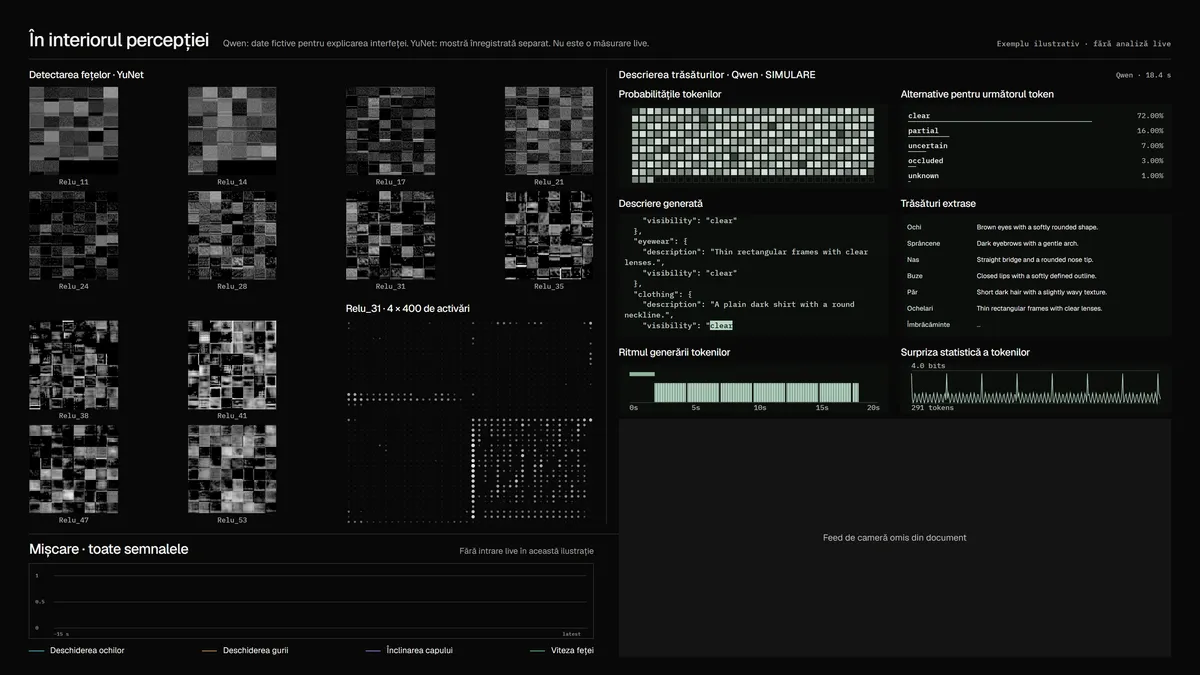
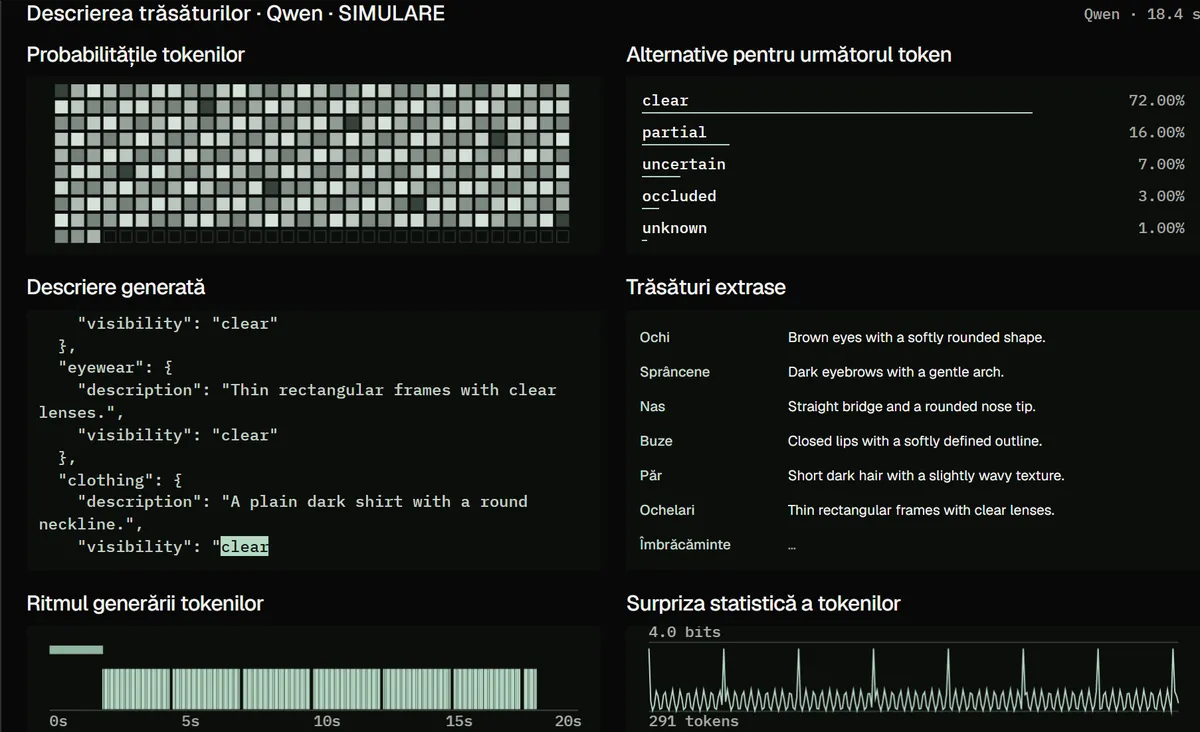
Perception presents the processes that precede the final image. On the left are the responses of the YuNet face detector. On the right, the Qwen panels track how the description takes shape. The camera image and movement charts connect these representations to the person standing in front of the installation.
Face detection
YuNet locates faces in the image. The black-and-white mosaics show activation maps from several layers of the network: each map contains responses to different areas of the image. Brightness makes their intensity visible within that particular map.
The dot grids enlarge a selection of these maps. Brighter dots indicate stronger responses; their distribution changes with the scene. The audience can thus follow how movement or a change in position alters the image's representation within the detector.
Describing the features
Qwen builds text from fragments called tokens. A fragment may represent a word, part of a word or a punctuation mark. At each step, the model calculates the probabilities of possible continuations, based on the image and the text already generated.
The six panels present different aspects of the same response:
| Panel | What it shows |
|---|---|
| Token probabilities | Each square represents a generated fragment. Brightness indicates the probability assigned to it. |
| Next-token alternatives | Several alternatives for continuing the text and the probability of each one. |
| Generated description | The text as it is produced, with recent fragments highlighted. |
| Extracted traits | Descriptions organised into categories such as eyes, hair or face shape. |
| Token generation rhythm | The appearance of fragments over time, from the initial wait to the sequence of text. |
| Token surprisal | How unlikely each fragment was to appear. A lower probability produces a higher peak. |
The probabilities describe the model's text choices. They do not measure the accuracy of a person's description. The panels make it possible to follow the generation process and compare the text with the features it describes.
The participant's movement
Landmarks drawn over the camera image track the face's position and movement. The Motion · all signals chart shows the last 15 seconds, with one row for each person being tracked. Four colours distinguish eye opening, mouth opening, head tilt and facial movement.
Indicators beside the image show the number of faces, bodies and hands detected, as well as the time taken to analyse a frame. The bass indicator shows the intensity associated with presence. The image, charts and sound thus offer complementary ways of perceiving the same participation.
03. Memory — the collection as part of the work
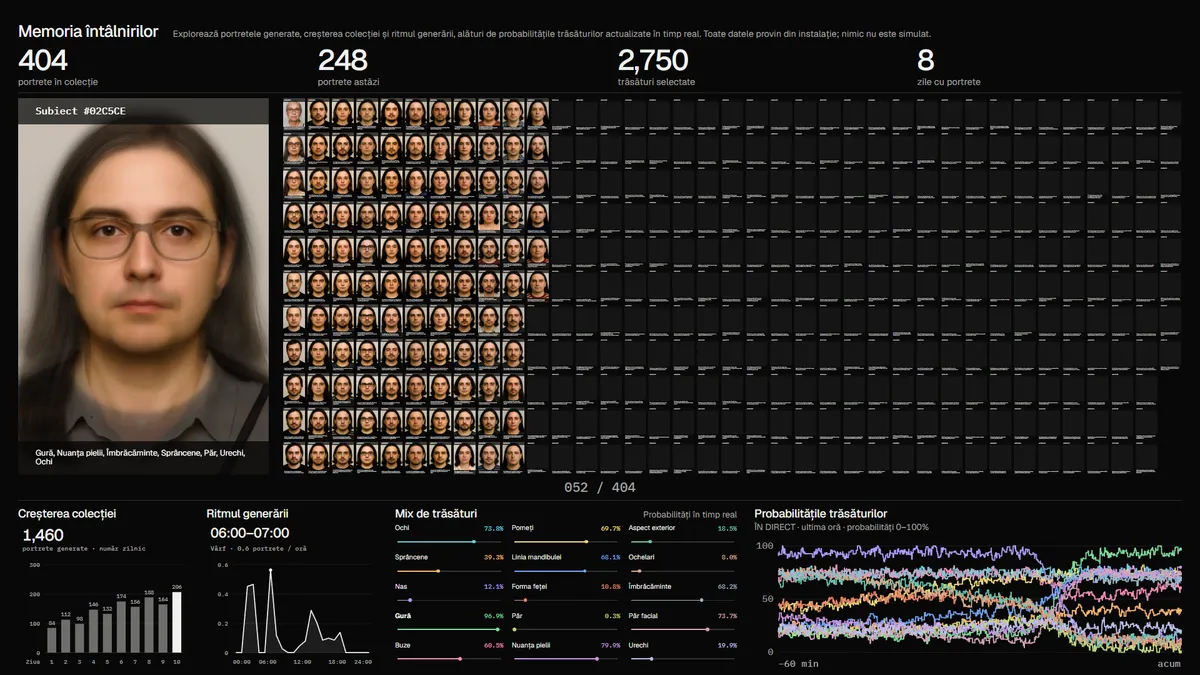
Memory relates the images to time. In the enlarged portrait area, faces from the collection appear in succession, while the adjacent mosaic allows them to be compared. What a single portrait cannot show becomes visible: the persistence of certain features, successive changes and differences between the stages of the work.
The counters show the number of portraits, images added that day, selected features and days on which results were created. The number beside the enlarged portrait indicates the image's position in the collection.
Selection changes over time
At each encounter, a few categories of features are selected. Their probabilities vary: sometimes the eyes are more likely to be chosen, at other times the hair or facial contours. Through this variation, participants can contribute to the portrait's transformation in different ways.
| Chart | What it shows |
|---|---|
| Collection growth | An illustrative representation of portraits accumulating from one day to the next. |
| Generation rhythm | The times of day at which portraits were added. |
| Trait mixer | The probability that each category will be included in the next contribution. |
| Trait probabilities | Changes in these probabilities over the last hour, with one colour for each category. |
The portraits and charts describe two aspects of the work: the images created and the changing selections that contribute to them. The collection makes it possible to follow this relationship across multiple encounters.
Recognising returning participants
The installation retains a numerical representation of the face to compare it with previous encounters. This representation can enable a participant to be recognised and is not anonymous. It is retained after the photograph is deleted, as are the descriptions and associations between encounters. The 10-minute limit applies to the temporary photograph.